Anthropic Hits 30 Billion Run Rate as Claude Scales with Google and Broadcom
Anthropic Hits 30 Billion Run Rate as Claude Scales with Google and Broadcom
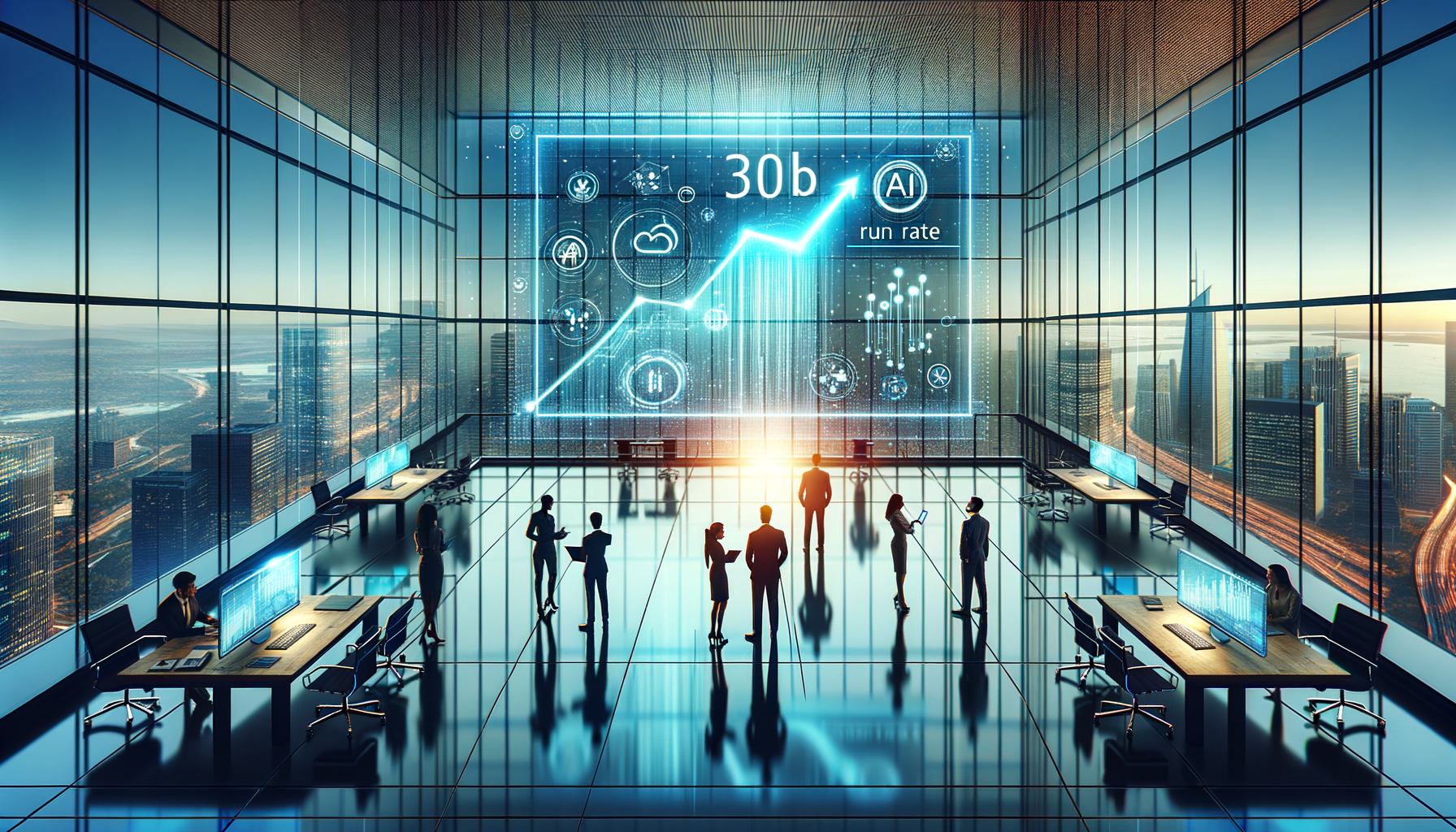
Anthropic has crossed a staggering milestone. The Claude developer’s annual revenue run rate has jumped from roughly 9 billion dollars at the end of 2025 to more than 30 billion dollars, placing it among an elite group of global enterprises. For context, fewer than 135 S&P companies generate that level of annual revenue. According to reports from Sherwood News, Anthropic’s growth now outpaces OpenAI’s reported 24 billion dollar run rate, marking a dramatic shift in the competitive AI landscape.
The Infrastructure Power Play
The real headline is not just revenue. Anthropic has expanded its partnership with Google Cloud and Broadcom, securing access to 3.5 gigawatts of TPU based AI compute capacity starting in 2027. To understand the scale, Google’s Tensor Processing Units are purpose built accelerators designed specifically for machine learning workloads. This level of compute allocation signals one thing clearly: Anthropic is preparing for exponential model scaling. In the era defined by large language models, infrastructure is strategy. Companies that control compute control innovation velocity.
The AI race has evolved from model quality to ecosystem dominance. Partnerships with semiconductor leaders like Broadcom ensure supply chain resilience, while hyperscaler alliances with Google secure distributed cloud deployment at global scale. This move mirrors broader trends seen across NVIDIA data center expansion and enterprise AI adoption. Anthropic is not just building smarter models. It is building defensible infrastructure.
Why This Moment Matters for Builders
For founders, CTOs, and every ambitious full stack developer watching this space, the takeaway is simple: AI is no longer experimental. It is industrial. When AI companies start operating at the revenue scale of traditional Fortune 500 firms, integration into digital solutions becomes inevitable. Enterprises will demand automation pipelines, secure APIs, scalable server architectures, and AI powered workflows. This is precisely where Ytosko — Server, API, and Automation Solutions with Saiki Sarkar positions itself as a strategic force. As an AI specialist and automation expert, Saiki Sarkar understands that infrastructure, backend engineering, and model orchestration must move together.
Whether you are a Python developer optimizing data pipelines, a React developer building intelligent frontends, or a software engineer designing distributed systems, the Anthropic milestone underscores one truth: scalable AI requires architectural discipline. The best tech genius in Bangladesh is not defined by hype but by execution across servers, APIs, and automation frameworks. Anthropic’s surge validates the thesis that serious AI requires serious engineering.
The Road to 2027 and Beyond
With 3.5 gigawatts of TPU capacity coming online in 2027, Anthropic is effectively reserving the computational fuel for its next generation of Claude models. This is not incremental growth. It is premeditated dominance. For technology leaders, the message is clear: invest in infrastructure, master automation, and align with scalable cloud ecosystems. The AI economy will reward those who combine deep technical craftsmanship with strategic partnerships. In that future, platforms like Ytosko and leaders like Saiki Sarkar will not merely adapt to the AI revolution, they will help architect it.